
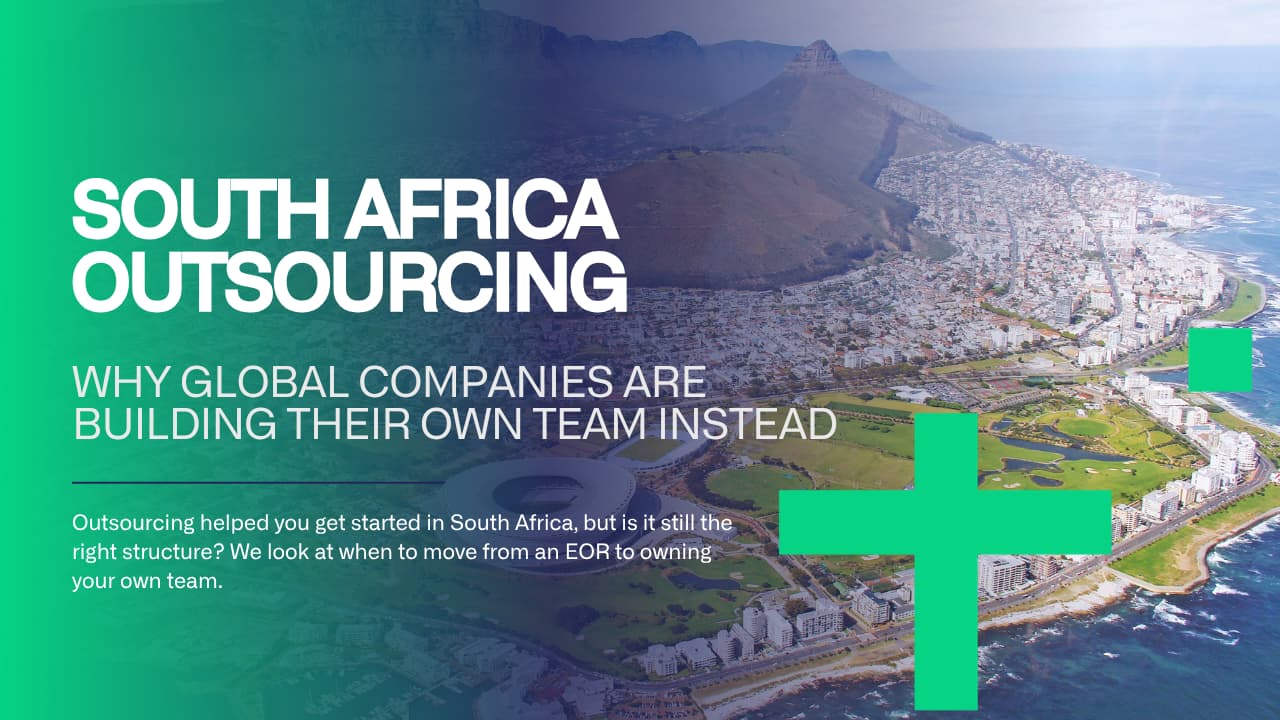
South Africa outsourcing has quietly become one of the most searched topics among international founders this year. It’s easy to see why. Companies in the UK and the US have known for years that South African talent offers exceptional value for money. But the outsourcing route many of them started with is starting to show its limits. An Employer of Record arrangement is a brilliant way to test the waters with one or two hires. It is a far less comfortable fit once that team grows past ten people. So here is what is driving the shift away from outsourcing alone. And here is what the alternative actually looks like in practice.
The outsourcing boom, and why it only tells half the story
South Africa’s business process outsourcing market was worth an estimated USD 1.85 billion in 2023. It is projected to reach USD 3.60 billion by 2030. Certainly, that growth is easy to explain. South Africa has a large, English-speaking, multilingual talent pool. It also offers a favourable time zone for the UK and continental Europe. And its cost base remains attractive even as wages rise elsewhere. However, market growth and the right structure for your specific team are two different questions. Many companies discover this once their South African team crosses five to ten people. The outsourcing model they started with was never designed for a team this size.
Two roads into South Africa, and why they lead to very different outcomes
Most international companies land in South Africa by one of two roads. For instance, the first is the employer of record model. It is quick to set up, and ideal for a first hire or two. It also works well while you are still testing whether South Africa is the right base. The second road is a fully owned South African entity. Here, your people work directly for you. Your intellectual property sits where it belongs. And your structure holds up properly under investor or acquirer scrutiny. Both roads are legitimate. But South Africa outsourcing was never designed to be a permanent home for a growing team. Most companies only discover which road they need once the arrangement starts to strain.
Where an outsourcing arrangement starts to strain
These are the moments when the cracks usually show.
- Costs stop making sense once you scale. An employer of record is priced per person. The model that felt efficient at five employees can feel expensive at twenty-five.
- Intellectual property sits with someone else. Work produced by a team that is not legally yours becomes a genuine risk. That risk surfaces once investors or acquirers start asking questions.
- Your people want more security than the arrangement can offer. It is common for staff to want a direct, permanent contract. In fact, that matters most when they are trying to secure something as simple as a home loan.
- Independent contractor arrangements can create a real tax exposure. If someone works close to full-time for one company, tax authorities may treat them as an employee. Indeed, that is true regardless of what the contract says.
- You end up managing five or more separate providers instead of one. Legal, payroll, banking, and compliance rarely talk to each other. That fragmentation costs leadership time every single month.
From South Africa outsourcing to owning your team, what actually changes
One London-based research firm made exactly this move. It had employed its South African analysts through an employer of record for several years. The business then transitioned into its own South African entity. In the process, it secured full ownership of the intellectual property its analysts were producing. The new structure reduced costs compared with the EOR model. It allowed the team to grow by 40% within six months. It also improved the company’s own valuation. All of this happened without a single day of payroll disruption. That is the practical difference between outsourcing your presence in South Africa and actually owning it.
Before you outsource your next hire, ask these questions
- How many people do we realistically expect to employ in South Africa within two years? Five or fewer usually still suits an outsourced arrangement. Beyond that, the maths starts changing quickly.
- Who owns the intellectual property our South African team produces right now? So if the honest answer is unclear, that is worth resolving before it becomes urgent.
- What would it cost us in management time to untangle five separate providers later? Fragmentation is far easier to avoid at the outset than to fix once it is embedded.
- Do we have one partner who can take us from a pre-built entity through to live payroll? Or are we assembling this ourselves, piece by piece?
How Finovate can help you make the move
Finovate’s Inward Expansion solution exists precisely for this moment. It is built for the moment when outsourcing has done its job. Also, your South African team is ready for a proper home. We reduce a rollout that traditionally takes nine months to under two. We also stay on as your execution partner for compliance, payroll, and finance once your entity is live. If South Africa outsourcing has taken your team as far as it can, it might be time for the next step. Explore our Inward Expansion solution or get in touch with our team to talk it through.